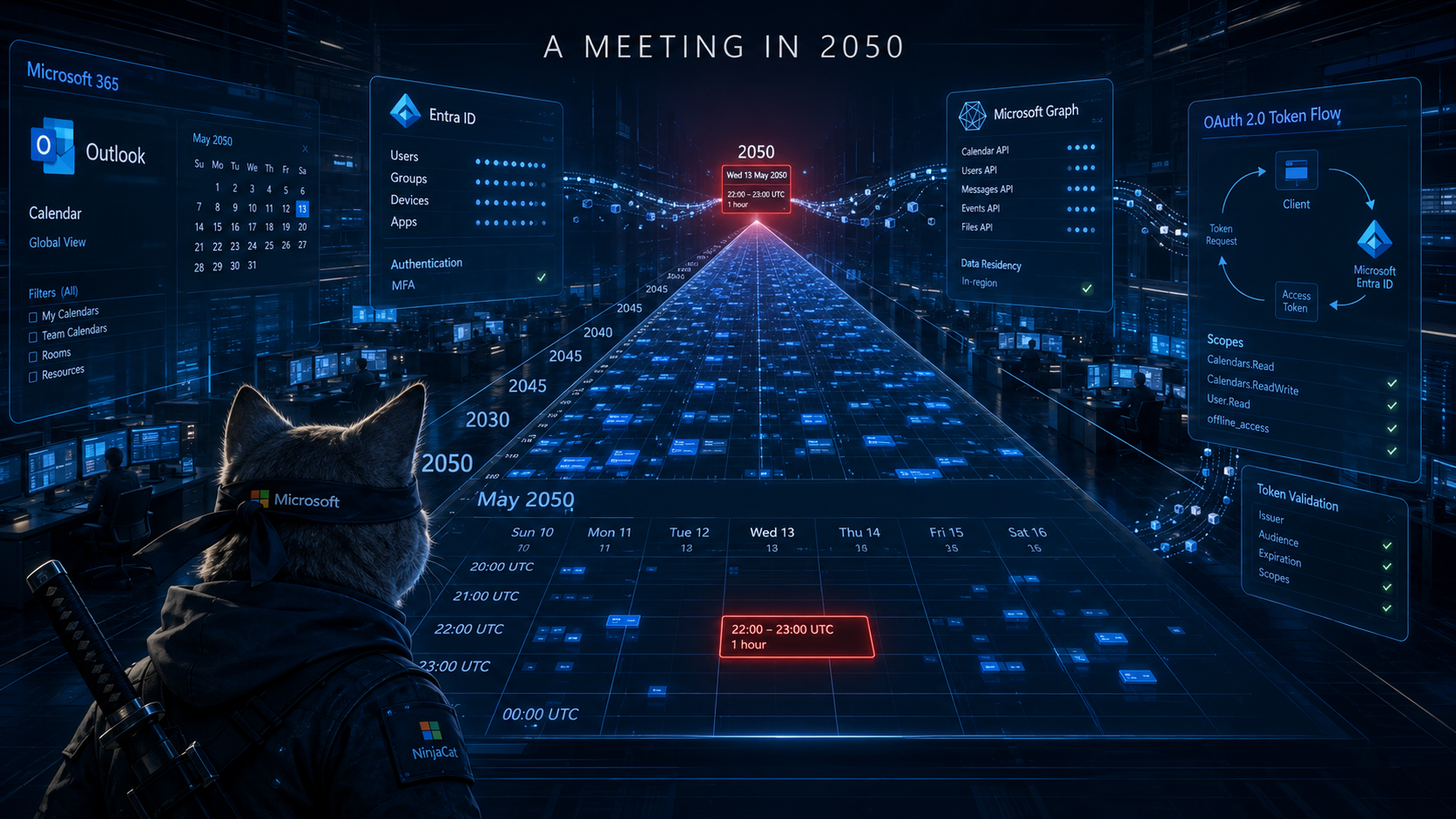
 There is a meeting on your calendar for 13 May 2050. Nobody will ever attend it. Nobody has ever scrolled there — a quarter-century out, in a fixed one-hour window between 22:00 and 23:00 UTC, parked in the most-synced, least-read database in your tenant.
That meeting is a command-and-control channel.
This week the attacker solved the detection problem in the most annoying way possible. They stopped bringing infrastructure. There is no C2 domain to block, because the C2 is graph.microsoft.com. There is no beacon on the wire to fingerprint, because the beacon is an OAuth token request to login.microsoftonline.com. There is no encryptor to signature, because the encryptor is manage-bde.exe and Microsoft signed it. There is no rogue admin console, because the console is your firewall’s. Every artifact this week belongs to you.
That thread ran through all seven of this week’s briefs and their 28 KQL candidates — a second SharePoint RCE wave (CVE-2026-58644), the WordPress core RCE (CVE-2026-63030) and its web-shell aftermath, ACR Stealer riding ClickFix lures into browser credential stores, BitLocker turned into an extortion tool against office print infrastructure, WebDAV remote paths used to launch execution, a Check Point SmartConsole authentication bypass (CVE-2026-16232) that ran Friday through Sunday, Teams external-guest social engineering, and Microsoft’s Q2 2026 email threat landscape with its machine-speed M365 attack chains. But the one that made me put down the coffee was Project CAV3RN storing its command-and-control traffic inside Outlook calendar events.
Last week’s theme was absence: the sign-in that never happened, the author who was never there. The detections won by demanding a corroborating record the attacker couldn’t forge. This week there is no absence to point at. Every record is present, legitimate, and signed.
So this week’s KQL of the Week is the CAV3RN calendar channel, told in three queries and one correction the briefs got wrong. Act I hunts the dead drop from inside the mailbox tenant. Act II hunts the infected host, which — and this is the part that matters — is almost never the same organization. The honorable mention hunts the fallback channel, where the attacker encodes their config into things that look exactly like IPv6 addresses and are not addresses at all.
🥇 Act I: The Standing Meeting Nobody Will Ever Attend
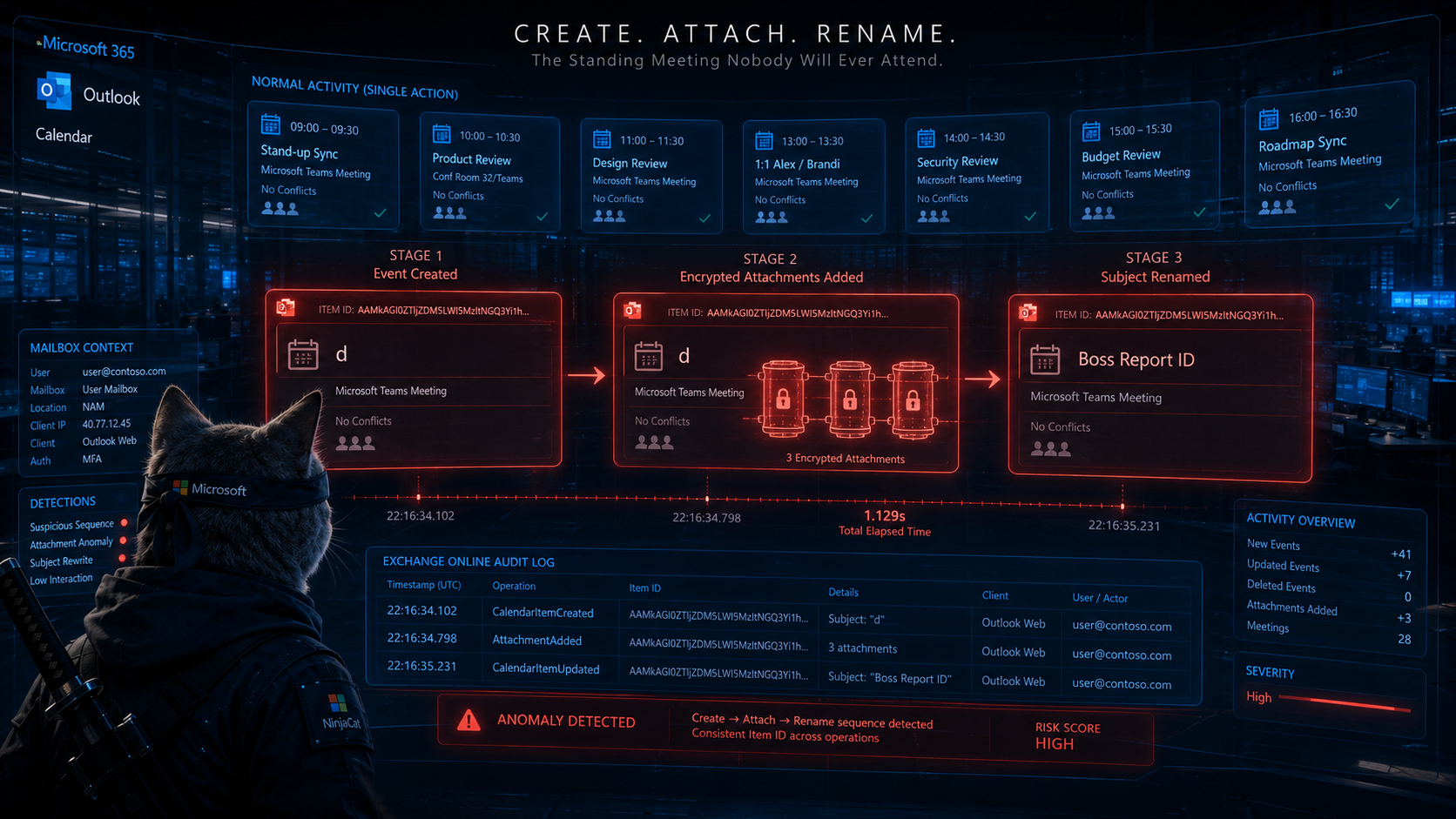
Here’s the problem the winning query solves.
On July 21, Kaspersky’s GReAT team published an analysis of a new Project CAV3RN communication module — a .NET Native AOT DLL named AzureCommunication.dll that replaces the framework’s older HTTP/WebSocket C2 component. The framework is tied, with low confidence, to OilRig (APT34), and the targeting is Israeli organizations. The briefs picked it up Tuesday, Wednesday, and Thursday and produced four separate detection candidates from it.
The mechanic is beautiful and infuriating in equal measure. The module authenticates to Microsoft Graph as an application — client_credentials grant, .default scope, no user in the loop — against a compromised third-party Microsoft 365 mailbox, and then uses that mailbox’s default calendar as a dead drop. Operator-to-agent commands arrive as encrypted attachments on a calendar event. Agent-to-operator results go back the same way. There’s even a heartbeat event, deleted and recreated on each cycle.
Every single one of those events lives in the same fixed one-hour window: 2050-05-13, 22:00–23:00 UTC. Not a rolling window. Not “next year.” A specific hour, a quarter-century from now, hardcoded, because a meeting in 2050 will never render in anyone’s Outlook view, ever.
The subjects are equally deliberate:
| Subject shape | Purpose |
|---|---|
Event ID: <agent-id> |
Operator → agent command; deleted after the agent consumes it |
Boss update ID: <agent-id>1500 |
Agent heartbeat; previous one deleted and replaced each cycle |
Boss Report ID: <agent-id>1500 |
Agent → operator command output |
d |
Temporary subject used at creation, before the real subject is patched on |
That last row is the one to stare at. The module doesn’t create an event with its final subject. It creates the event with a placeholder, uploads the encrypted attachments, and then PATCHes the subject into place. Which means the mailbox audit log records a create, then a subject rewrite, seconds apart, on the same item — a shape that legitimate calendaring almost never produces, because Outlook sends you the whole event in one operation.
So the detection has three independent handles: the marker strings, the single-character placeholder subject, and the create-then-rename latency. It does not need to know anything about 2050 — the calendar year is what makes triage take thirty seconds instead of thirty minutes.
The KQL
let lookback = 7d;
let RenameWindowSec = 300;
let DeadDropMarkers = dynamic(["Event ID:", "Boss update ID:", "Boss Report ID:"]);
let CalendarFolderNames = dynamic(["Calendar","Kalender","Calendrier","Calendario","Agenda","カレンダー","日历","Календарь","לוח שנה"]);
let CalendarOps = OfficeActivity
| where TimeGenerated > ago(lookback)
| where OfficeWorkload =~ "Exchange"
| where Operation in~ ("Create", "Update", "SoftDelete", "HardDelete", "MoveToDeletedItems")
// Item is a STRING column in OfficeActivity, not dynamic. parse_json() is required.
| extend ItemJson = parse_json(Item)
| extend
    ItemId      = tostring(ItemJson.Id),
    ItemSubject = coalesce(tostring(ItemJson.Subject), ItemName),
    FolderPath  = coalesce(tostring(ItemJson.ParentFolder.Path), Folder)
| where FolderPath has_any (CalendarFolderNames)
| where isnotempty(ItemId)
// The mailbox is the entity, and MailboxGuid is the only stable name for it —
// it survives a UPN change and is populated more reliably on app-only records.
// UserId is the ACTOR. It is never a fallback for a mailbox. Check the casing
// of MailboxGuid in your own workspace before you run this.
| extend Mailbox = coalesce(tostring(MailboxGuid), MailboxOwnerUPN)
| where isnotempty(Mailbox)
| project
    TimeGenerated, Mailbox, MailboxOwnerUPN, ItemId, ItemSubject, Operation, FolderPath,
    UserId, UserType, ClientIP, ClientInfoString, AppId;
let MarkerHits = CalendarOps
| where ItemSubject has_any (DeadDropMarkers)
// long(null), matching tolong() below. int and long unioned together split into
// two columns the first time either side's type changes.
| extend Signal = "SubjectMarker", RenameLatencySec = long(null);
let PlaceholderRenames = CalendarOps
// Sort key and partition guard must both be the FULL entity: an item ID is only
// unique within a mailbox, so Mailbox comes first and both keys are compared below.
| sort by Mailbox asc, ItemId asc, TimeGenerated asc
| extend
    PrevMailbox = prev(Mailbox),
    PrevItemId  = prev(ItemId),
    PrevOp      = prev(Operation),
    PrevSubject = prev(ItemSubject),
    PrevTime    = prev(TimeGenerated)
| where Mailbox == PrevMailbox and ItemId == PrevItemId
| where PrevOp =~ "Create" and Operation =~ "Update"
// between (1 .. 2), NOT <= 2 — an empty PrevSubject would otherwise match every create/update pair
| where strlen(trim(@"\s", PrevSubject)) between (1 .. 2)
| where isnotempty(ItemSubject) and PrevSubject != ItemSubject
| extend RenameLatencySec = tolong(datetime_diff('second', TimeGenerated, PrevTime))
| where RenameLatencySec between (0 .. RenameWindowSec)
| extend Signal = "PlaceholderRename"
| project-away Prev*;
let Findings = union MarkerHits, PlaceholderRenames
| extend EventKey = strcat(Mailbox, "|", ItemId, "|", tostring(TimeGenerated), "|", Operation);
// Stage 1 — corroboration is settled at the ITEM, not the mailbox.
// The two branches test different FACTS, not different events: MarkerHits reads
// the subject's content after the patch; PlaceholderRenames reads the transition.
// The protocol forces both to resolve on the same Update record, so DistinctEvents == 1
// is the TIGHTEST association available, not a duplicate. It leads the ranking.
let ItemVerdicts = Findings
| summarize
    ItemSignals    = make_set(Signal),
    DistinctEvents = dcount(EventKey)
    by Mailbox, ItemId
| extend
    ItemCorroborated    = array_length(ItemSignals) > 1,
    ItemMarkerViaRename = array_length(ItemSignals) > 1 and DistinctEvents == 1;
// Stage 2 — the mailbox is the REPORTING unit. Counts are de-duplicated on EventKey
// for the same reason: a dual-signal row must not inflate the volume it's ranked on.
Findings
| summarize
    Events       = dcount(EventKey),
    Items        = dcount(ItemId),
    Signals      = make_set(Signal),
    Subjects     = make_set(ItemSubject, 10),
    Operations   = make_set(Operation, 10),
    Actors       = make_set(UserId, 5),
    ActorTypes   = make_set(UserType, 5),
    Clients      = make_set(ClientInfoString, 5),
    ClientIPs    = make_set(ClientIP, 5),
    AppIds       = make_set(AppId, 5),
    UPNs         = make_set(MailboxOwnerUPN, 3),
    MinRenameSec = min(RenameLatencySec),
    FirstSeen    = min(TimeGenerated),
    LastSeen     = max(TimeGenerated)
    by Mailbox
| join kind=leftouter (
    ItemVerdicts
    | summarize
        MarkerViaRenameItems = countif(ItemMarkerViaRename),
        CorroboratedItems    = countif(ItemCorroborated),
        SuspectItems         = count()
        by Mailbox
  ) on Mailbox
| project-away Mailbox1
| extend
    BothSignals = CorroboratedItems > 0,
    MixedActors = array_length(ActorTypes) > 1
// MarkerViaRenameItems first: marker content arriving VIA a placeholder rename on one
// record is the CAV3RN signature. Two signals spread across two records on the same
// item is a looser association and ranks below it.
| order by MarkerViaRenameItems desc, CorroboratedItems desc, MixedActors desc, Items desc, Events desc
The line that does the work
Not the marker list. Markers are strings, strings are free, and the operator can change Boss Report ID: to Q3 Planning Sync in the time it takes to recompile. It’s this:
| where strlen(trim(@"\s", PrevSubject)) between (1 .. 2)
Note between (1 .. 2) and not <= 2. Item.Subject is not guaranteed to be populated on Create records the way it is on Update records — and if it comes back empty, strlen() returns zero, zero satisfies <= 2, and the filter matches every create-then-update pair in the tenant. The marker branch of this query fails toward silence when extraction breaks. Written with <= 2, this branch fails toward noise. Same missing field, opposite direction, and only one of them is obvious from reading the results.
But I want to be precise about what that operator actually buys, because it is easy to read this as “I picked the safe one” and it isn’t. It’s a build gate, and it only has two settings.
If Subject is populated on Create in your tenant, between (1 .. 2) is correct and the branch works: the placeholder the module writes is a single character, so excluding the empty case costs nothing and it’s the difference between a hunt and a pager. If Subject is not populated on Create in your tenant, then between (1 .. 2) doesn’t make this branch safe — it makes it structurally incapable of ever firing on real CAV3RN activity, silently, because every genuine placeholder rename arrives with an empty PrevSubject and gets discarded by the guard. Switching back to <= 2 doesn’t rescue it either; that’s the firehose. There is no operator that makes an absent field into a working detection.
So run this before you build anything on top of it, and read the Item blob on a Create with your own eyes:
OfficeActivity
| where TimeGenerated > ago(1d)
| where OfficeWorkload =~ "Exchange"
| where Operation =~ "Create"
| where isnotempty(Item)
| take 20
| project Operation, ItemName, Item
If Subject is in there, ship the rename branch. If it isn’t, delete the branch rather than tuning it, and lean on the two lanes that don’t depend on it: the marker strings above, and the AADServicePrincipalSignInLogs anti-join further down — which is keyed on token acquisition and doesn’t care what Exchange writes into a subject field at all. A detection you can’t validate the input for isn’t a conservative detection. It’s an unknown wearing a threshold.
Beyond that, this is the detection with a shelf life. The placeholder subject isn’t a naming choice the operator made for fun — it’s forced by the protocol. The module cannot create the event with its final subject, because it needs an event ID to attach the encrypted payload to, and it doesn’t want a half-built dead drop sitting in the calendar advertising itself while the upload is in flight. Create blank, attach, then rename. That sequence is load-bearing. Rename the markers all you like; the create-then-patch shape stays, because the alternative is a race condition in your own C2.
The supporting choice is the entity-keyed union. MarkerHits and PlaceholderRenames are two genuinely different questions, and I’ve unioned them anyway — but only because both sides are projected to the same columns and both resolve to the same entity. The summarize then earns its keep: BothSignals promotes anywhere a marker string and a placeholder rename both landed, which is the CAV3RN shape and essentially nothing else’s.
Which is a claim you have to actually honor, and my first two versions didn’t — in opposite directions, which is what makes the pair worth walking through.
Version one grouped too finely. I used by MailboxOwnerUPN, UserId, UserType — the entity, plus two attributes of the record. Every extra key in a by clause is a finer partition, and a finer partition is a smaller chance that two signals about the same thing land on the same row. If Exchange attributes the marker write to the service principal and the rename to the mailbox owner, those become two rows, array_length(Signals) is 1 on both, and BothSignals — the entire point of the union — can never fire. The rule that falls out: anything that isn’t the entity belongs in the aggregation, not the by clause. Actors = make_set(UserId, 5) tells you the same thing without fragmenting the row. And it tells you something extra — MixedActors flags a mailbox whose calendar writes are attributed to both a service principal and an interactive owner.
Version two then grouped too coarsely, and fixing that surfaced the more interesting question. Trace a real dead drop through both branches. The module creates the event with subject d, then PATCHes Boss Report ID: A1B2C3D1500 onto it. That Update row is the rename target — so it satisfies PlaceholderRenames. It is also the row whose subject now contains a marker string — so it satisfies MarkerHits. One audit record, two branches, two rows in the union. Summarized straight to the mailbox, Events = count() reports two events where Exchange logged one, and the number an analyst reads as “how much of this is there” is doubled.
So the volume counters get de-duplicated: Events = dcount(EventKey) where EventKey is item, timestamp and operation. That part is uncontroversial.
And then I overcorrected, which is the part worth reading. Having established that one record was producing two rows, I carried the same de-duplication into the corroboration flag — ItemCorroborated required two distinct signals and DistinctEvents > 1, on the reasoning that two signals on one record couldn’t be two independent findings. Run the canonical CAV3RN item through that and it returns false. The marker and the rename both resolve on record #2, DistinctEvents is 1, the clause fails, and BothSignals — the flag whose entire job is to promote the CAV3RN shape — excludes the CAV3RN shape specifically. With CorroboratedItems leading the sort, a real dead drop would have ranked below incidental single-signal noise.
The mistake was collapsing two different questions. Is this one event or two? is a volume question, and EventKey answers it correctly. Are these two independent findings? is a corroboration question, and I answered it with the machinery built for the first one. The branches don’t test two events. They test two different facts about the same item: MarkerHits reads the subject’s content after the patch, PlaceholderRenames reads the transition — a one-character subject replaced within seconds. Those tests are independent of each other. That they land on the same audit record isn’t duplication, it’s the protocol: the module must patch the marker onto a placeholder, so marker-content and rename-shape are forced to coincide on one row. Requiring them not to is requiring the malware not to work the way this section spends four paragraphs explaining it works.
Which flips the sign on DistinctEvents rather than removing it:
ItemMarkerViaRename— two signals, one record. The marker arrived via a placeholder rename. This is the tightest association the data can express and it leads theorder by.ItemCorroborated— two signals on the item, however they fell. Looser, still worth promoting, ranks second.Events— de-duplicated onEventKey, because volume still shouldn’t double-count.
The general form: de-duplicate your counts, not your corroboration. A record satisfying two independent tests is one event and two findings, and a query that can’t hold both of those at once will get one of them wrong.
All of which refines the rule above rather than contradicting it — anything that isn’t the entity still stays out of the by clause. The correction is that “the entity” depends on the question. For correlating signals, it’s the calendar item. For reporting a finding, it’s the mailbox. Collapsing those two into one summarize is how a query ends up proving something about itself.
And the mailbox key changed for the same class of reason. The old version wrote coalesce(MailboxOwnerUPN, UserId), which is a mailbox with an actor as its fallback — two different entity types sharing one column, so a mailbox with no UPN on the record silently becomes whoever Exchange thought was acting. coalesce(tostring(MailboxGuid), MailboxOwnerUPN) keeps both candidates in the same species, prefers the identifier that survives a rename, and leaves UserId where it belongs: in Actors, as an attribute of the finding.
This is worth stating precisely, because the briefs got it wrong on Tuesday and it’s an easy mistake to make. A union is legitimate when the branches share an entity key and illegitimate when they don’t. Tuesday’s Detection 4 unioned calendar Graph activity (keyed on AccountId) with a DNS AAAA volume spike (keyed on DeviceName), then padded the second branch with AccountId = "", CalendarOps = 0, ActionTypes = dynamic([]) so the schemas would line up. The result is two unrelated hunts sharing an output grid, with half the columns structurally empty on every row. Nothing correlates, because there’s nothing to correlate on — the brief’s own caveat notes that IPAddress from CloudAppEvents and DeviceName from DeviceNetworkEvents can’t be equated without a device inventory. If you’re padding columns to make a union compile, you don’t have one detection. You have two, in a trench coat.
A KQL note…
prev() requires a serialized row set, and sort by provides that serialization. Two things about that line will bite you, and they’re covered properly in the bonus section below — but the short version, because it changes whether this query works at all:
| sort by Mailbox asc, ItemId asc, TimeGenerated asc— theascis not decorative. KQL’ssort bydefaults to descending. Omit it andprev()hands you the later row, inverting the entire sequence test into a silent no-op.| where Mailbox == PrevMailbox and ItemId == PrevItemId—prev()walks the whole serialized table and does not respect groups. Without that guard, the first row of every calendar item borrows the last row of the previous item, and you manufacture “sequences” that never occurred. Note that the guard names both keys, because an item ID is only unique inside a mailbox: the partition key has to be the full entity, not the part of it that looks unique.
Keeping it honest
The briefs filed the CAV3RN calendar work as hunting-only every time it appeared, and that’s correct. Here’s what has to be true before this means anything:
Itemis astringcolumn, not a dynamic one, and dot access on it will not run. This is the trap I nearly shipped.OfficeActivitytypesItemas String — “represents the item upon which the operation was performed” — and the same is true ofAffectedItemsandFolders. The schema does have genuine dynamic columns (OperationProperties,Members,ExtraProperties), so the distinction is deliberate, not an artifact of the docs. WriteItem.Subjectand you don’t get an empty result, you get a semantic error.parse_json(Item)first, every time. There is also noParentFoldercolumn at all — there’sFolderandFolders— which is why the query above coalesces the parsed path againstFolderrather than trusting either alone.ItemNameis likewise a first-class column documented as carrying the subject, and if it’s populated for calendar records in your tenant it’s cheaper and steadier than digging into the blob. Validate all of it before you build:OfficeActivity | where OfficeWorkload =~ "Exchange" | where isnotempty(Item) | take 20 | project Operation, Item, ItemName, Folder. Wednesday’s brief made the same class of assumption in the other direction, filtering onOperation in ("UpdateCalendarItem", "CreateCalendarItem", ...)— operation names that aren’t in the Exchange audit schema at all. Its own caveats section flags this. Survey the real values before you trust any of it.Calendaris an English string. The folder-path test above matches a name list for exactly that reason. A tenant running localized Outlook stores the same folder asKalender,Calendrier,カレンダー, orלוח שנה— and given this campaign’s targeting, the Hebrew case is not hypothetical. A hardcodedhas "Calendar"is a silent false negative in precisely the environments most likely to be affected. Confirm what your own tenant writes:OfficeActivity | where OfficeWorkload =~ "Exchange" | summarize count() by Folder | order by count_ desc.- Subject content is a licensing and configuration question. Mailbox audit logging must be enabled and the Office 365 connector configured, and some tenants restrict subject capture on privacy grounds. A hunt that depends on reading meeting subjects is a hunt that needs sign-off from someone other than you.
- Wednesday’s version keyed on
UserAgent, and that field belongs to the attacker. The query filtered to calendar operations where the user agent didn’t containMozilla,Outlook,Microsoft Office, orMacOutlook. Consider what that asks of the adversary: set one HTTP header to a string starting withMozillaand the detection is gone. This is an allowlist built entirely from a value the client controls, which is the same failure family as authenticating on a claim you didn’t verify. Worse, the precedingisnotempty(UserAgent)drops every record where the field isn’t populated — and the brief’s own caveats note thatUserAgentis unreliable for Graph API calls inOfficeActivity. The filter over-trusts what it sees and discards what it doesn’t. Neither half is recoverable by tuning. - Volume thresholds are the wrong axis for this threat. Tuesday gated on
CalendarOps > 20over seven days; Thursday onCallCount > 20. A room-booking integration clears twenty calendar operations before lunch. A CAV3RN agent polling every six hours clears twenty-eight in a week — barely over the line, and one config change from being under it. You cannot separate a beacon from a business integration by counting, because busy is not the same as regular. If you want to go at this from the cadence side, measure the variance of the inter-arrival gaps, not the total. - Thursday’s Detection 3 queried the wrong table entirely. It hunted
AuditLogsfor Graph calendar operations.AuditLogsis Entra ID’s directory control plane — app registrations, consent grants, role assignments, group membership. Reading or writing a calendar event is data plane, and it does not write anAuditLogsrecord no matter how many times it happens. The query is syntactically fine, will run without error, and will return nothing forever. For app-only Graph activity, the tables that actually see it areOfficeActivity/MailboxAudit(the operation),CloudAppEvents(if you’re licensed for Defender for Cloud Apps), andAADServicePrincipalSignInLogs(the token acquisition). That last one is genuinely useful here and no brief this week reached for it:
// The baseline must be scoped to the SAME resource as the population, or the
// anti-join answers "new service principal" instead of "new to Graph" -- and
// silently drops the likeliest case: an app registration that has existed for
// years against other resources and started calling Graph last week.
let Baseline = AADServicePrincipalSignInLogs
| where TimeGenerated between (ago(180d) .. ago(30d))
| where ResultType == 0
| where ResourceDisplayName =~ "Microsoft Graph"
| distinct AppId;
AADServicePrincipalSignInLogs
| where TimeGenerated > ago(30d)
| where ResultType == 0
| where ResourceDisplayName =~ "Microsoft Graph"
| summarize
    SignIns     = count(),
    IPs         = make_set(IPAddress, 10),
    DistinctIPs = dcount(IPAddress),
    Countries   = make_set(Location, 10),
    FirstSeen   = min(TimeGenerated),
    LastSeen    = max(TimeGenerated),
    ActiveDays  = dcount(bin(TimeGenerated, 1d))
    by AppId, ServicePrincipalName, ServicePrincipalId
| join kind=leftanti Baseline on AppId
| extend ObservedSpanDays = datetime_diff('day', LastSeen, FirstSeen)
// DistinctIPs and ActiveDays are triage columns, NOT filters. A threshold here
// would be the volume-gating mistake from two bullets down; read them, don't gate on them.
| order by FirstSeen desc
The leftanti is doing the load-bearing work, and it’s worth saying why, because the obvious version of this query silently can’t answer the question. FirstSeen = min(TimeGenerated) is bounded by the lookback. Inside a 30-day window, a service principal that has been running since 2023 reports the same FirstSeen as one registered last Tuesday — the aggregate cannot see past its own filter, and “new” is not a property you can compute from a single window. It’s a membership question, which means it needs a population to be absent from. Hence the 180-day baseline and the anti-join: authenticating now, and not in the six months before now. Last week’s operator, doing this week’s job.
Every CAV3RN get and send cycle starts with a client_credentials token request, so the token acquisition is the one part of the channel that can’t be moved. What the query selects is exactly one thing: successful app-only Graph authentication with no successful Graph authentication in the six months prior. What you then read off the result is the shape — DistinctIPs, ActiveDays, ObservedSpanDays, Countries. A beacon looks like a small number of addresses, near-daily activity, and a span that runs to the edge of the window. A legitimately new integration usually looks like a burst, or a rollout, or a single day. Those are triage columns and I’ve deliberately left them unthresholded — gating on them would be the counting mistake from two bullets down, in a query that’s supposed to demonstrate the alternative.
The baseline scope is the part to copy, though, and it’s the part I had wrong at first. My first version baselined on every successful service principal sign-in and compared it against a Graph-only population. That doesn’t answer “new to Graph.” It answers “new service principal” — and it silently discards the case you’d most want, which is an app registration that has been authenticating to some other resource for two years and started calling Graph last week. A compromised existing registration is at least as plausible here as a freshly minted one, and the mismatched baseline made it invisible. An anti-join is only as honest as the symmetry between its two sides: if the population is filtered and the baseline isn’t, every filter you applied to one side becomes a false “seen before” on the other.
- Neither mailbox identifier is guaranteed to be populated, and app-only access is precisely where
MailboxOwnerUPNgoes missing. Group on an empty key and every such record collapses into a single row that appears to represent one mailbox and actually represents all of them. Thecoalesce(tostring(MailboxGuid), MailboxOwnerUPN)and theisnotempty()guard exist for that — and note the order: GUID first, because it’s the stable identifier and it’s the one that tends to survive on app-only records. What the old version did instead was fall back toUserId, which is not a mailbox at all; that turns a missing-field problem into a wrong-entity problem, which is harder to see because the output still looks populated. Confirm both columns before you rely on either:OfficeActivity | where OfficeWorkload =~ "Exchange" | summarize Records = count(), WithGuid = countif(isnotempty(MailboxGuid)), WithUPN = countif(isnotempty(MailboxOwnerUPN)) by UserType. Same failure family as thestrlencase above: a missing field turning a filter into a firehose, or a key into a fiction. - And the finding is a lead, not a verdict. Confirm in the mailbox, not in the SIEM. Pull the item and look at its start time. If it’s a real meeting, it’s on a real date. If it’s a dead drop, it’s in 2050. That’s the whole triage step.
Act I hunts the mailbox. Which raises the question the briefs never asked — and it’s the one that changes your coverage.
🥈 Act II: You Are Probably Not the Mailbox
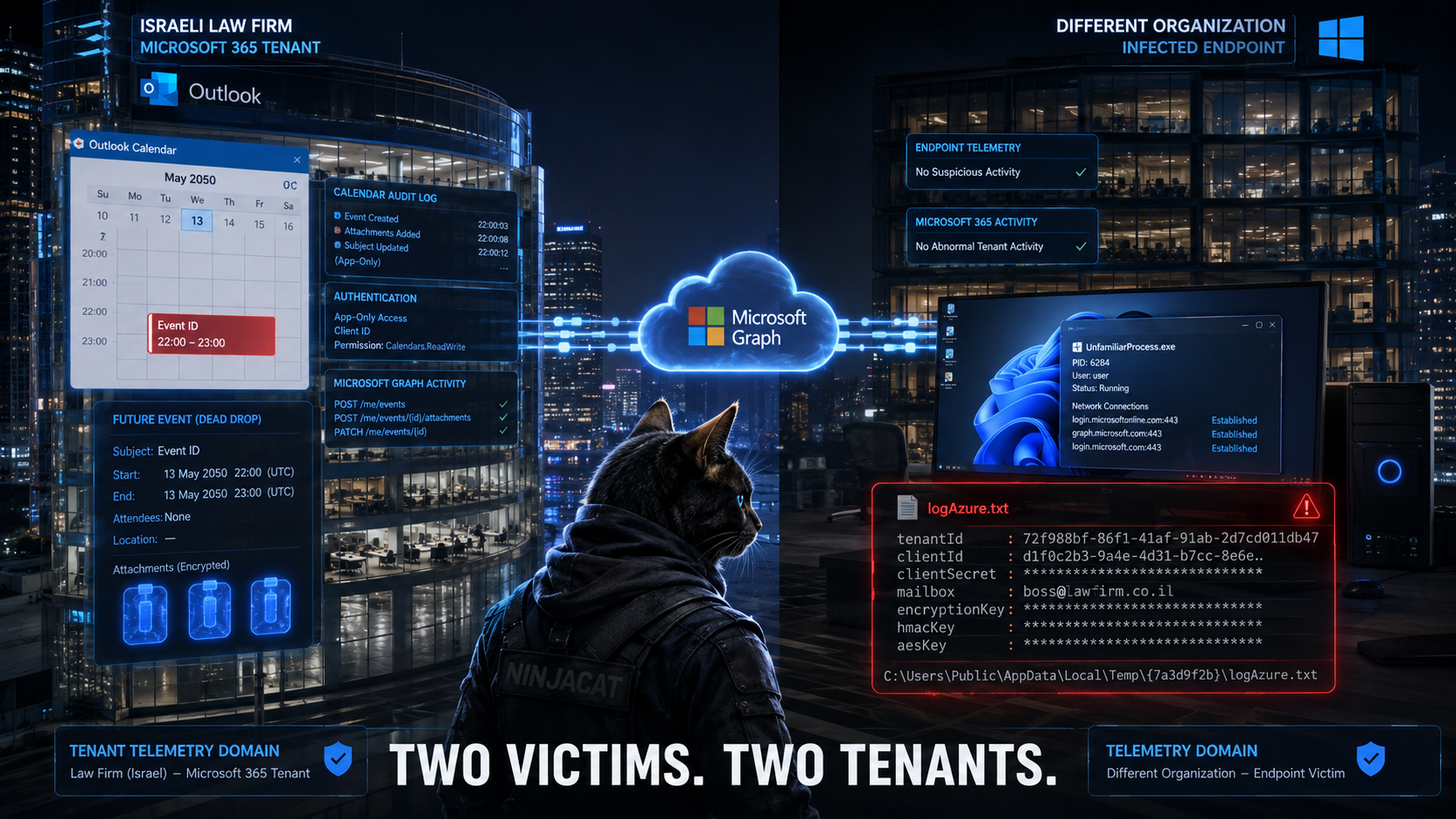
Every CAV3RN detection filed this week hunts tenant-side telemetry: CloudAppEvents, OfficeActivity, AuditLogs. Calendar operations, service principals, Graph calls. All of it assumes the suspicious calendar activity will show up in your logs.
Read the GReAT analysis again, though. The dead-drop mailbox belongs to a compromised Israeli law firm — a third party. The infected endpoints are somewhere else entirely. Those are two different organizations, two different tenants, two different SOCs.
Which means there are two victims in this campaign and they have almost nothing in common:
- If you are the mailbox tenant, you have full visibility. The calendar operations, the app-only sign-ins, the placeholder renames — all of it lands in your audit log. Act I is your query. You may also have no infected endpoints at all; your role in this intrusion is hosting the drop box.
- If you are the endpoint victim, you have none of that. The calendar operations happen in someone else’s tenant. Your
OfficeActivityis clean. YourCloudAppEventsis clean. Your service principal sign-in logs are clean. From your side, an unremarkable process makes ordinary HTTPS connections tologin.microsoftonline.comandgraph.microsoft.com— two hosts that are allowlisted on every proxy on earth, including yours.
Run Act I against an infected fleet and it returns nothing, forever, and the nothing looks exactly like health. That’s not a tuning problem. It’s a telemetry-domain mismatch, and it’s the most expensive kind of blind spot because the query appears to be working.
So Act II changes sides. And the best detection for the endpoint victim turns out to be five lines long.
The module looks for a relative file named logAzure.txt before it does anything. If the file isn’t there, it builds the configuration from hardcoded values and writes the whole thing to disk — tenant ID, client ID, client secret, target mailbox, DNS bootstrap host, and both RSA keys, in JSON. Because the code supplies only a filename with no path, Windows resolves it against the working directory of whatever process loaded the DLL.
That’s not a C2 artifact. That’s a plaintext credential file dropped into an arbitrary directory by the malware itself, and it is the highest-fidelity, lowest-cost signal in this entire campaign.
There’s a second one, and getting to it requires saying out loud something the endpoint framing makes easy to skip: AzureCommunication.dll is a DLL. It has no process of its own. GReAT never recovered the updated controller — what they assess is that something loads this DLL and calls its export. That’s a deliberately modest claim and I want to keep it modest, because the detection consequence doesn’t need any more than it. Whatever InitiatingProcessFileName your network telemetry records for this module’s Graph traffic belongs to the thing that loaded it, whatever that thing is. Land it in a signed host that’s already on your allowlist and a detection built on “which processes talk to Graph” reads an expected name and moves on. The blind spot is not that the operator spoofs a process name. It’s that they never have to touch the name at all.
Which means the process-behavior branch below cannot stand on its own, and the fix is to ask the question one layer down: which processes loaded a module by that name at all. DeviceImageLoadEvents answers that, it costs the same as the filename check, and it hands you the loader identity for free — which is the thing you actually need in order to know where logAzure.txt went.
The KQL
let lookback = 30d;
let ConfigArtifacts = dynamic(["logAzure.txt"]);
let ModuleImages    = dynamic(["AzureCommunication.dll"]);
let GraphEndpoints  = dynamic(["graph.microsoft.com", "login.microsoftonline.com"]);
let ExpectedGraphClients = dynamic([
    "outlook.exe", "olk.exe", "teams.exe", "ms-teams.exe", "msteams.exe",
    "onedrive.exe", "msedge.exe", "chrome.exe", "firefox.exe",
    "excel.exe", "winword.exe", "powerpnt.exe", "onenote.exe",
    "officeclicktorun.exe", "msoia.exe",
    "powershell.exe", "pwsh.exe", "azurecli.exe", "msedgewebview2.exe",
    "mssense.exe", "senseir.exe", "msmpeng.exe",
    // Windows itself. svchost (Web Account Manager / TokenBroker) alone will dominate
    // login.microsoftonline.com volume on every managed fleet.
    "svchost.exe", "searchhost.exe", "searchapp.exe", "runtimebroker.exe",
    "backgroundtaskhost.exe", "phoneexperiencehost.exe", "microsoft.sharepoint.exe"
    // Deliberately NOT here: rundll32.exe, regsvr32.exe, dllhost.exe. They produce
    // little legitimate Graph traffic in most estates and exist to run other people's
    // code. If yours are noisy against Graph, add them from your own baseline query
    // and understand what you're giving up -- don't inherit them from this list.
]);
let ConfigWrites = DeviceFileEvents
| where Timestamp > ago(lookback)
| where ActionType in ("FileCreated", "FileModified", "FileRenamed")
| where FileName in~ (ConfigArtifacts)
// Row-level branch: first and last are the same instant. Name them anyway, so the
// union carries one vocabulary and the outer summarize has nothing to guess about.
// Connections/ActiveDays are long(0) here for the same reason — they describe the
// network branch, and 0 reads as "not a network finding", not as a missing value.
| extend FirstSeen = Timestamp, LastSeen = Timestamp
| extend Connections = long(0), ActiveDays = long(0)
| project
    FirstSeen, LastSeen, DeviceId, DeviceName,
    Process     = InitiatingProcessFileName,
    ProcessPath = InitiatingProcessFolderPath,
    Account     = InitiatingProcessAccountName,
    Connections, ActiveDays,
    Detail      = strcat(FolderPath, " <- ", InitiatingProcessCommandLine)
| extend Signal = "ConfigArtifactWrite";
// The module is a DLL. This branch is the only one that sees it regardless of
// which host process loaded it — including the module hosts on the allowlist above.
// It is not more durable than the filename check; it is durable against a
// DIFFERENT thing. Both die on a rename in the next build.
let ModuleLoads = DeviceImageLoadEvents
| where Timestamp > ago(lookback)
| where FileName in~ (ModuleImages)
| extend FirstSeen = Timestamp, LastSeen = Timestamp
| extend Connections = long(0), ActiveDays = long(0)
| project
    FirstSeen, LastSeen, DeviceId, DeviceName,
    Process     = InitiatingProcessFileName,
    ProcessPath = InitiatingProcessFolderPath,
    Account     = InitiatingProcessAccountName,
    Connections, ActiveDays,
    Detail      = strcat(FolderPath, " loaded by ", InitiatingProcessFileName,
                         " [", coalesce(SHA256, "no hash"), "]")
| extend Signal = "ModuleImageLoad";
let UnexpectedGraphClients = DeviceNetworkEvents
| where Timestamp > ago(lookback)
| where ActionType == "ConnectionSuccess"
| where isnotempty(RemoteUrl)
// RemoteUrl is populated inconsistently -- sometimes a bare host, sometimes a full
// URL with scheme, port, or path. Exact equality against a hostname list silently
// misses every non-bare form. Normalize to a host, THEN match exactly.
// This is a positive selector, so breadth here is free; the endswith-vs-has_any
// argument later applies to SUPPRESSION filters, where breadth is a hole.
| extend RemoteHost = tolower(tostring(split(
             trim_start(@"[a-zA-Z]+://", tostring(RemoteUrl)), "/")[0]))
| extend RemoteHost = tostring(split(RemoteHost, ":")[0])
| where RemoteHost in~ (GraphEndpoints)
| where isnotempty(InitiatingProcessFileName)
| where not(InitiatingProcessFileName in~ (ExpectedGraphClients))
| summarize
    FirstSeen   = min(Timestamp),
    LastSeen    = max(Timestamp),
    Connections = count(),
    ActiveDays  = dcount(bin(Timestamp, 1d)),
    Endpoints   = make_set(RemoteHost, 5)
    by DeviceId, DeviceName,
       Process     = InitiatingProcessFileName,
       ProcessPath = InitiatingProcessFolderPath,
       Account     = InitiatingProcessAccountName
// Detail carries the endpoints only. Connections and ActiveDays stay first-class
// columns so they can be sorted, filtered, and thresholded — not parsed out of prose.
| extend
    Detail = strcat_array(Endpoints, ", "),
    Signal = "UnexpectedGraphClient"
| project-away Endpoints;
union ConfigWrites, ModuleLoads, UnexpectedGraphClients
// DeviceId ONLY. DeviceName is a label: it collides across a fleet and changes on
// rename, and a rename mid-window would split one host into two findings.
| summarize
    DeviceNames = make_set(DeviceName, 3),
    Signals     = make_set(Signal),
    Processes   = make_set(Process, 10),
    Paths       = make_set(ProcessPath, 10),
    Accounts    = make_set(Account, 5),
    Details     = make_set(Detail, 10),
    Connections = sum(Connections),
    ActiveDays  = max(ActiveDays),
    FirstSeen   = min(FirstSeen),
    LastSeen    = max(LastSeen)
    by DeviceId
| extend
    HasConfigArtifact = set_has_element(Signals, "ConfigArtifactWrite"),
    HasModuleLoad     = set_has_element(Signals, "ModuleImageLoad"),
    SignalCount       = array_length(Signals),
    RenamedInWindow   = array_length(DeviceNames) > 1,
    ActiveSpanDays    = datetime_diff('day', LastSeen, FirstSeen)
// Fidelity first, then breadth, then behavior. Raw volume is not in the ordering
// at all — a beacon and a busy integration are not separable by counting.
| order by SignalCount desc, HasModuleLoad desc, HasConfigArtifact desc, ActiveDays desc, LastSeen desc
The line that does the work
| where FileName in~ (ConfigArtifacts)
That’s it. Two words of logic against DeviceFileEvents, and it beats every clever thing in this article on cost-per-unit-confidence. logAzure.txt is not a filename that appears in legitimate software. There is no tuning phase, no baseline, no threshold, no exclusion list. It runs in seconds across thirty days of fleet telemetry and it either returns zero rows or it returns an incident.
It is also, obviously, a fragile detection — it dies the moment the developers change one string in the next build. So it’s paired, not standalone, and the pairing is the point. The other two branches each answer a question the filename doesn’t.
ModuleLoads asks: did anything on this host load a module by that name, and what loaded it? That’s the branch that survives the process-host problem, and it’s the one I’d have missed if I’d stopped at the endpoint framing. A DLL borrows its loader’s identity in every process-keyed table on the box — DeviceNetworkEvents, DeviceProcessEvents, proxy logs, all of it. DeviceImageLoadEvents is where the module is still itself. It costs the same as the filename check and it returns the loader path, which is the fact that turns “something on this host is beaconing” into “this specific service is compromised.”
Be precise about what that buys, though, because I overstated it in the first cut and the overstatement is the kind that gets baked into a coverage map. ModuleLoads is not more durable than ConfigWrites. Both are string matches on a name the developers chose. AzureCommunication.dll and logAzure.txt die in the same commit, and a build that renames one will rename the other. What ModuleLoads is durable against is a different axis: the operator’s choice of host process, which they can change without recompiling anything. That’s worth having, and it’s worth ranking, but it is not longevity — it’s coverage of a variable the adversary can turn today rather than next release. Treat both as short-lived, and treat the third branch as the one that has to still work after the rename.
UnexpectedGraphClients asks: which processes on this endpoint are talking to Microsoft Graph, and are they processes that have any business doing so? Graph is a browser-and-Office-suite destination. A binary that isn’t in that family, authenticating to login.microsoftonline.com and then calling graph.microsoft.com, is doing something a normal endpoint does not do. But note what that branch cannot see, and why the ordering of the three matters: it is keyed on the host process, and the host process is not a property of the module. GReAT did not recover the updated controller — they assess that it loads the DLL and calls its export, and the loading mechanism is unestablished. Which is precisely why this branch is fragile: whatever the mechanism turns out to be, the operator picks the host, and picking a host that’s on your allowlist requires no change to the DLL at all. Land inside svchost.exe and the branch is structurally silent, because svchost.exe has to be on the list — Web Account Manager alone would bury you. That is not a tuning problem. It’s why the generic module hosts are excluded from the default list with a comment, and why ModuleLoads exists.
The ordering that falls out of all this is SignalCount first, then the two fidelity flags. Two independent branches agreeing on one device outranks any single branch, however good that branch is — the same discipline as Act I’s CorroboratedItems, applied to a host instead of a mailbox.
Note the grouping key: DeviceId, alone. All three branches are host-scoped, all three resolve to a device, and the summarize collapses them onto one row per endpoint. My earlier version grouped by DeviceId, DeviceName, which is the exact mistake this article spends a paragraph on two sections later — DeviceName is a label, it changes on rename, and a rename inside a thirty-day window splits one compromised host into two half-findings, each below the bar. It’s in the aggregation now as DeviceNames = make_set(DeviceName, 3), where it costs nothing and buys something: RenamedInWindow turns the rename from a defect into a triage fact. That’s what a legitimate union looks like — same entity, three questions, one verdict. Contrast Thursday’s version, which correlated graph_callers back to the full network stream with join kind=inner ... on DeviceName and then filtered InitiatingProcessFileName =~ SuspectProcess after the fact. It gets the right answer, but it fans out first — a device with four suspect processes multiplies every candidate row by four before the filter throws three away. The fix is to join on the compound key up front:
| extend SuspectProcess = InitiatingProcessFileName
| join kind=inner graph_callers on DeviceId, SuspectProcess
Same answer, a fraction of the shuffle — and note that it’s DeviceId, not DeviceName. If the argument three paragraphs up is that the entity key is what makes a correlation legitimate, then the key has to be the one that actually identifies the entity. DeviceName is a label. It collides across a fleet, it changes on rename, and it’s the reason half the “correlated” detections in circulation quietly fan out across two unrelated hosts that a naming convention happened to give the same string.
Keeping it honest
I’d take ConfigWrites and ModuleLoads to a scheduled rule tomorrow. UnexpectedGraphClients is a hunt, and the gap between those two states is where the work is:
- A process allowlist is a statement about processes, and this is a module. Spelled out above, repeated here because it’s the bullet people skip.
AzureCommunication.dllhas no process identity of its own; every process-keyed table on the box records whatever loaded it. GReAT didn’t recover the updated controller, so nobody outside the operator knows what that is — and the honest consequence is thatUnexpectedGraphClientshas a hole whose shape you cannot predict from the reporting.svchost.exe,powershell.exe,msedgewebview2.exeandbackgroundtaskhost.exeare on the list legitimately and are all capable of hosting it. TreatUnexpectedGraphClientsas the branch that catches an implementation that didn’t think about this,ModuleLoadsas the branch that doesn’t care, and don’t report coverage from the first without the second. If you can’t ingestDeviceImageLoadEventsat fleet scale — and plenty of shops can’t, it’s a high-volume table — scope it to the module name at the connector rather than dropping the branch. - The generic module hosts are deliberately absent from the default list.
rundll32.exe,regsvr32.exeanddllhost.exeare not inExpectedGraphClients, and that’s a choice rather than an oversight: they generate little legitimate Graph traffic in most estates, and they’re the entries whose inclusion costs the most. If they’re noisy in yours, add them — but derive that from your own baseline query rather than inheriting it from mine, and note what you’re conceding when you do. - Both name-matched branches have the same expiry date.
ConfigWritesandModuleLoadsare string matches on developer-chosen names, and one rename retires both. Don’t let the fidelity ranking imply otherwise: high confidence today is not the same as durable, and a coverage map that records “CAV3RN — covered” on the strength of two filename matches is recording a date, not a capability. Re-derive both strings from the next round of reporting rather than assuming they held. - Thursday’s allowlist has last week’s bug in it. The query excluded destinations with
not(RemoteUrl has_any ("graph.microsoft.com", "login.microsoftonline.com", "microsoft.com", "windows.com", "windowsupdate.com")). The hole is real, and the reason is simpler than the one I first wrote.has_anyis term matching against an index — Microsoft’s documentation is explicit that these operators test whether terms are present, not where they sit. Presence is not position, and an allowlist means to ask a question about position: does this name end here.windowsupdate.com.attacker.iocontains the terms the needle is made of; a term test says yes; a suffix test says no. Registermicrosoft.com.c2.example.netand you walk out the same door. I originally spelled out a token-adjacency model to explain exactly which hostnames slip through, and I’ve cut it — that model is inferred from observed behaviour rather than documented, and the argument doesn’t need it. Presence-versus-position is enough, it’s what the docs actually say, and building a suppression filter on inferred semantics is the failure mode here regardless of which inference you make. This is theRemoteIP startswith "172."mistake from the AsyncAPI honorable mention wearing different clothes: an operator whose semantics almost fit, used in a filter whose job is to suppress, where every over-broad match is an invisible hole. Act II uses exact host equality after normalization, which cannot over-suppress. If you need to cover subdomains,endswithon a normalized hostname is the floor. - The expected-client list is the whole detection, and mine is not yours. Every enterprise runs Graph SDK background services nobody documented: RMM agents, backup tools, CASB shims, HR integrations, a PowerShell scheduled task somebody wrote in 2023. Run
DeviceNetworkEvents | where RemoteUrl in~ ("graph.microsoft.com") | summarize count() by InitiatingProcessFileName, InitiatingProcessFolderPath | order by count_ descand build the list from your own fleet before this goes anywhere near a schedule. - Name-only exclusions are spoofable, and
teams.exefrom%TEMP%is notteams.exe. Harden to(FileName, FolderPath)pairs or signer checks before promotion — the same correction the CI/CD detection needed last week, for the same reason. RemoteUrlis neither reliably populated nor consistently shaped inDeviceNetworkEvents. Two separate problems. First, a connection recorded with onlyRemoteIPwill never match at all and drops out silently — a false-negative direction, which is the safer failure, but know it’s there: your Graph-client inventory is a floor, not a census. Second, when it is populated the value arrives in different shapes depending on the sensor path — sometimes a bare host, sometimes with a scheme, a port, or a trailing path. My first version ranRemoteUrl in~ (GraphEndpoints)straight against it, which matches the bare form and nothing else, so the branch would have gone quiet on exactly the estates where the field is richest. The query now strips scheme, path and port to aRemoteHostand matches that. Note this doesn’t contradict theendswith-over-has_anyargument in the previous bullet: that one is about a suppression filter, where every over-broad match is an invisible hole. This is a positive selector, where breadth costs nothing and a missed form costs you the finding. Survey the real values first:DeviceNetworkEvents | where RemoteUrl contains "graph.microsoft" | summarize count() by RemoteUrl | take 20.- Working directory means the path is unpredictable. Because the module supplies a bare filename,
logAzure.txtlands wherever the host process happened to be running —System32, a user profile, a service directory, anywhere. Don’t scope the file query byFolderPath. Let it fire from anywhere and read the path as evidence: where it landed tells you which process loaded the DLL. -
An aggregate collapses a time range into whatever fields you name — and a field you didn’t name is a field the analyst will infer wrongly. My first version summarized the network branch to
Timestamp = min(Timestamp)before the union, so the outermax(Timestamp)faithfully reported the maximum of a set of minimums, which is a number that describes nothing.LastSeen: 29 days agoon a host that has been beaconing every day since is how a live finding gets triaged to the bottom of the queue. Carryminandmaxthrough any branch that aggregates, and reconcile them at the top.ActiveDaysis the field that actually answers the question anyway: a config write is a point event, but a Graph client is a behavior, and “180 connections across 28 of 30 days” is a different finding from “180 connections in one afternoon.”And having argued that, my first version then computed
ActiveDays,strcat‘d it into a human-readableDetailstring, andproject-awayed the column. Which is a subtler version of the same mistake: the number was present and it was no longer data. You can’t sort on it, you can’t threshold on it, you can’t put it in anorder by, and the analyst reads it out of a sentence instead of a grid. A field you buried in a string is a field you deleted, with extra steps. Carry it as a column, keep the string for the parts that are genuinely prose, and let the ranking use the number. It’s now third in theorder by, behind the two fidelity flags and ahead of recency, which is where it belongs. - Coverage is the silent gate, again. No MDE agent, no
DeviceFileEvents, no finding. A quiet result across a fleet you haven’t fully onboarded is a coverage report wearing a clean bill of health.
Act I hunts the drop box. Act II hunts the agent. The last act hunts what the agent does when the drop box stops answering.
🎖 Honorable Mention: The Address That Was Never an Address
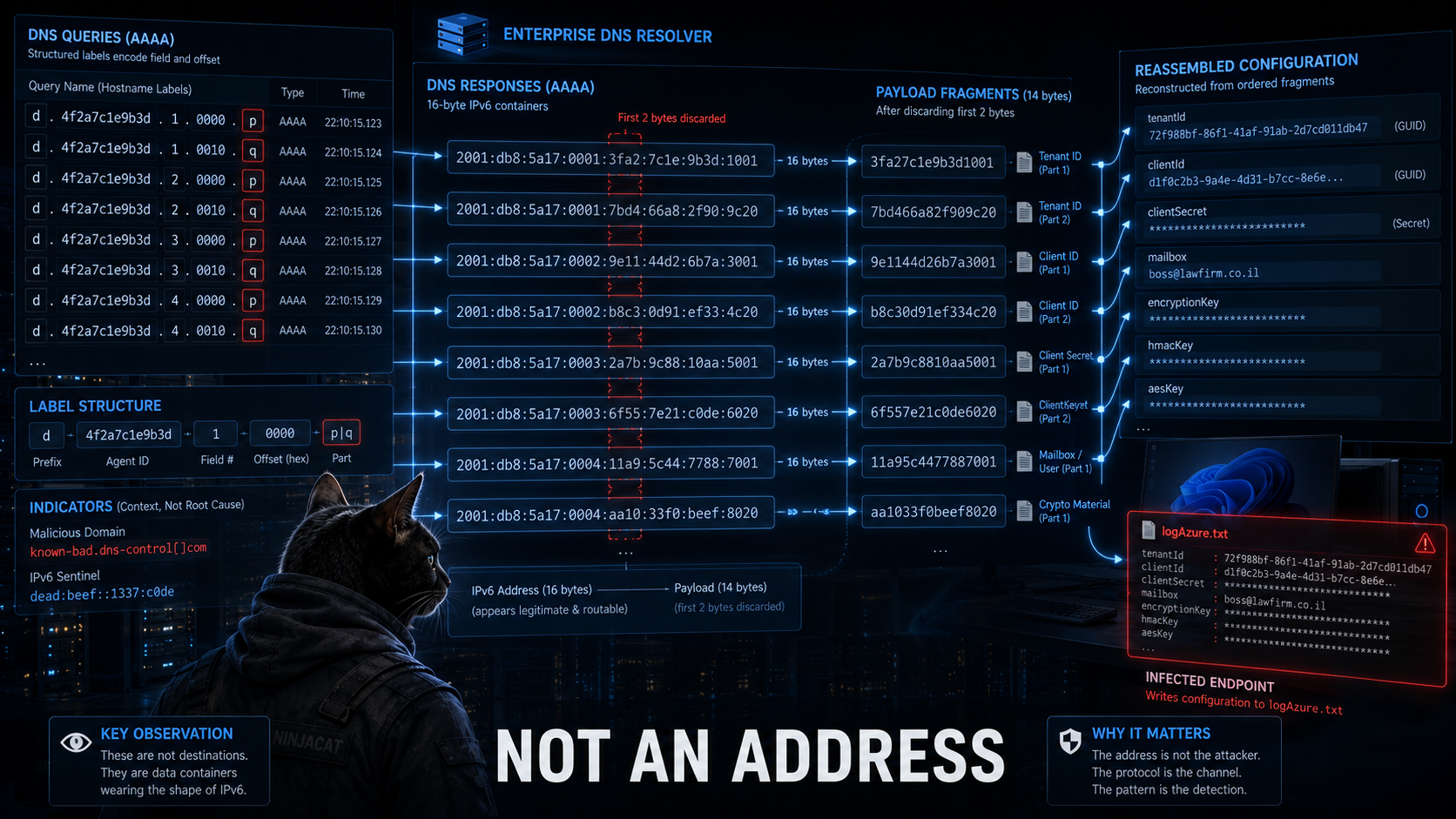
If Acts I and II win on where they point, the third query wins on the sheer nerve of what it’s looking for.
CAV3RN has a fallback. When the OAuth token request fails, or the GET /v1.0/organization validation call comes back wrong — the tenant got cleaned up, the app registration got revoked, the secret rotated — the module doesn’t die and it doesn’t phone a backup C2. It re-reads its own configuration out of DNS.
The mechanism is the good part. The module queries AAAA records against an actor-controlled domain (cloudlanecdn[.]com, delegated to four in-bailiwick nameservers that all resolve to the same two addresses — logical redundancy, not real redundancy). The IPv6 addresses that come back are not addresses. They’re 16-byte containers. The module throws away the first two bytes and treats the remaining fourteen as payload, reassembling a new tenant ID, client ID, client secret, and mailbox address fragment by fragment, then writing the whole recovered config back to logAzure.txt and reconnecting.
The query structure is where it becomes detectable, because the protocol has to encode a lot into a hostname:
d.<hex-agent-id>.<field-index>.p.<host>asks for a field’s lengthd.<hex-agent-id>.<field-index>.<offset>.q.<host>asks for 14 bytes at an offset
The agent ID is seven characters, hex-encoded to fourteen, and embedded in every single query. So the detectable shape is: a leftmost label d, a second label of even-length hexadecimal, and a bare single-character p or q marker label sitting between the parameters and the domain. That’s a lot of structure for something pretending to be a hostname.
let lookback = 7d;
let BootstrapDomains = dynamic(["cloudlanecdn.com"]);
// Single-token prefilter, derived from the registrable label only. A hostname ending
// in ".cloudlanecdn.com" must contain "cloudlanecdn" as a whole indexed term, because
// dots delimit it on both sides -- so this is PROVABLY broader than the boundary test
// below and cannot discard a row the authoritative check would have kept. No
// multi-token adjacency behaviour is relied on anywhere.
let BootstrapTerms   = dynamic(["cloudlanecdn"]);
let FailureSentinel  = "2001:4998:44:3507::8000";
// Shared, cheap base. Nothing expensive happens here.
let AaaaLookups = DnsEvents
| where TimeGenerated > ago(lookback)
| where SubType =~ "LookupQuery"
| where QueryType =~ "AAAA"
| extend QueryName = tolower(trim_end(@"\.", Name));
// Lane 1 — protocol shape. The label-count floor belongs to THIS lane only.
let ShapeLane = AaaaLookups
| where QueryName startswith "d."          // leading-label test, cheap, drops nearly everything
| extend Labels = split(QueryName, ".")
| where array_length(Labels) >= 5
| extend SecondLabel = tostring(Labels[1])
| where strlen(SecondLabel) >= 8 and strlen(SecondLabel) % 2 == 0
| where SecondLabel matches regex @"^[0-9a-f]+$"   // regex last, on the smallest surviving set
| where set_has_element(Labels, "p") or set_has_element(Labels, "q")
| extend
    Lane        = "ProtocolShape",
    MarkerLabel = iff(set_has_element(Labels, "p"), "p", "q")
| project TimeGenerated, ClientIP, Computer, QueryName, Lane, MarkerLabel;
// Lane 2 — bootstrap domain IOC. No label-count floor: the bare domain is two labels.
// Cheap single-token prefilter, then exact apex-or-suffix as the authoritative test.
// Narrow with something cheap, DECIDE with something structured -- same pattern as
// the sentinel lane, and the prefilter is chosen so it can only over-match.
let DomainLane = AaaaLookups
| where QueryName has_any (BootstrapTerms)
| mv-apply Dom = BootstrapDomains to typeof(string) on (
    summarize DomainHits = countif(QueryName == Dom or QueryName endswith strcat(".", Dom))
  )
| where DomainHits > 0
| extend Lane = "BootstrapDomain", MarkerLabel = ""
| project TimeGenerated, ClientIP, Computer, QueryName, Lane, MarkerLabel;
// Lane 3 — failure sentinel in the ANSWER. Cheap lossy prefilter, then authoritative compare.
// IPv6 has no single textual form. 2001:4998:44:3507::8000 and its expanded
// equivalent are the same address and different strings — so narrow on a term,
// decide with ipv6_compare().
let SentinelLane = AaaaLookups
| where IPAddresses has "8000"
| mv-apply AnswerIP = split(tostring(IPAddresses), ",") to typeof(string) on (
    summarize SentinelHits = countif(ipv6_compare(trim(@"\s", AnswerIP), FailureSentinel) == 0)
  )
| where SentinelHits > 0
| extend Lane = "FailureSentinel", MarkerLabel = ""
| project TimeGenerated, ClientIP, Computer, QueryName, Lane, MarkerLabel;
union ShapeLane, DomainLane, SentinelLane
// One lookup can satisfy more than one lane — d.<hex>.<idx>.p.cloudlanecdn.com hits
// both Shape and Domain. EventKey de-duplicates so Queries counts DNS events, not
// union rows. LaneHits counts rows, and the two being different is the point.
| extend EventKey = strcat(tostring(TimeGenerated), "|", QueryName)
// ClientIP is the entity. Computer is the RESOLVER that logged the query, not the
// host that asked — a client talking to two DNS servers would fragment into two rows.
| summarize
    Queries       = dcount(EventKey),
    LaneHits      = count(),
    DistinctNames = dcount(QueryName),
    Resolvers     = make_set(Computer, 5),
    SampleNames   = make_set(QueryName, 10),
    MarkerLabels  = make_set_if(MarkerLabel, isnotempty(MarkerLabel)),
    ShapeCount    = dcountif(EventKey, Lane == "ProtocolShape"),
    DomainCount   = dcountif(EventKey, Lane == "BootstrapDomain"),
    SentinelCount = dcountif(EventKey, Lane == "FailureSentinel"),
    Lanes         = make_set(Lane),
    FirstSeen     = min(TimeGenerated),
    LastSeen      = max(TimeGenerated)
    by ClientIP
| extend
    ShapeSeen    = ShapeCount > 0,
    SentinelSeen = SentinelCount > 0,
    DomainSeen   = DomainCount > 0,
    LaneCount    = array_length(Lanes)
// Rank by fidelity, not volume — a noisy IOC-only hit must not outrank a single shape hit
| order by ShapeSeen desc, SentinelSeen desc, LaneCount desc, DistinctNames desc
The line that does the work is the shape test, and specifically this half of it:
set_has_element(Labels, "p") or set_has_element(Labels, "q")
Note what that isn’t. It isn’t QueryName has ".p.". has tests for a term, and the punctuation you wrote to mean “a label, delimited by dots” is not part of that test — the dots are separators, not content, so the predicate you shipped is a question about the term p appearing somewhere in the name, not about a label sitting between two dots. That’s the failure worth naming, and it’s the same one as the allowlist above: not a filter that matches too much, but a filter that quietly answers a different question than the one on the page. It also isn’t a positional index like Labels[array_length(Labels) - 3], which assumes the registrable domain is exactly two labels and breaks the moment the operator moves to something under .co.uk. set_has_element() does exact element matching against the parsed label array — it asks “is there a label that is precisely the single character p,” which is a question ordinary DNS almost never answers yes to. Splitting the hostname into labels first and reasoning about labels as structured data, rather than pattern-matching against the string, is what makes the test both specific and portable. And it’s the version that doesn’t require you to be right about tokenizer internals: structured comparison against parsed labels means the same thing in every workspace, documented or not.
One line up in the shared base is doing quiet, load-bearing work, and it deserves naming because lifting the regex without it produces a clean zero-row result:
| extend QueryName = tolower(trim_end(@"\.", Name))
The agent ID is hex-encoded uppercase. ^[0-9a-f]+$ does not match A1B2C3. Whether your resolver preserves query case varies by source — the Windows DNS connector generally lowercases, Sysmon generally doesn’t — so the normalization is the difference between a working detection and a detection that works only on your test box. Normalize before you pattern-match, always, and never let case survive into a regex you’re relying on.
The domain and sentinel lanes are the cheap IOC lanes riding alongside — cloudlanecdn[.]com and the hardcoded failure address 2001:4998:44:3507::8000 (which lives inside a Yahoo allocation, for reasons GReAT couldn’t determine either). Those two will be dead within the month. The shape lane outlives them.
Six things about how those lanes are handled, four of which I got wrong on the first pass:
- The domain lane decides on a boundary, and prefilters on a single token. Two changes, for two different reasons. The boundary test is a consistency fix rather than a correction:
has_anywould return the right rows in a positive lane, where extra breadth costs nothing, and the Act II argument about allowlists doesn’t apply to a filter whose job is to select. But code travels and comments don’t — a reader lifting this block into an exclusion list inherits exactly the hole Act II describes, and the comment explaining why it was safe stays behind on this page. The prefilter change is the sharper one. My first version prefiltered withhas_any(BootstrapDomains)— a multi-token needle — and then argued at length about how KQL tokenizes both sides and matches adjacent runs. Microsoft documentshas_anyas indexed term matching; the adjacency model is inferred behaviour, not a documented contract, and I had it sitting upstream of the authoritative test where any row it wrongly drops is invisible. That’s the same structural mistake as trusting a suppression filter you can’t see the misses of. The fix is to prefilter on the registrable label alone,cloudlanecdn: a single token relies on no adjacency behaviour at all, and it’s provably broader than the boundary test, because any name ending in.cloudlanecdn.commust containcloudlanecdnas a whole term with dots delimiting it on both sides. It can over-match; it cannot under-match. Themv-applystill makes the call. Keep the cheap-narrow / structured-decide shape — just don’t let the cheap half depend on behaviour the docs don’t promise. - Don’t string-match an IPv6 address.
IPAddresses has "2001:4998:44:3507::8000"only fires if your resolver logged that exact compression. The same address written2001:4998:44:3507:0:0:0:8000is a different string and an identical destination, and the miss is silent.ipv6_compare()normalizes both sides and answers the question you actually asked. It would be a strange article that spends a paragraph arguing structured label matching beats string matching, and then string-matches an address three lines later. - But put something cheap in front of it. My first version ran the
mv-applyand the address comparison against every AAAA lookup in the window, and filtered afterwards. That is the expensive operation sitting upstream of the filter that would have contained it — on an IPv6-enabled network it’s a query that returns the right answer and never finishes. The fix is| where IPAddresses has "8000"ahead of themv-apply. KQL’s tokenizer treats the colon as a separator, so the trailing hextet is a distinct term in every textual form of that address, and the final group is always four hex digits — there’s no zero-padded variant that hides it. Narrowing with a string operation and deciding with a structured one is not a contradiction; it’s the whole pattern. The mistake is letting the string operation make the call. - Separate lanes, not shared booleans. Computing
ShapeMatch,DomainMatch, andSentinelMatchas columns on one row set forces every row through every test, and it couples their preconditions. That coupling had already broken something:| where LabelCount >= 5is a shape precondition, but sitting at the top of a single pipeline it also discarded every domain-IOC hit on the barecloudlanecdn.com— two labels — and every sentinel hit returned to a short hostname. Threelet-bound branches let each lane carry its own floor. The union at the bottom is legitimate for the usual reason: same entity,ClientIPandComputer, three questions. max()doesn’t aggregate booleans, so theShapeSeen/DomainSeen/SentinelSeenflags are built with counting functions and compared after thesummarize. And the ordering runs onShapeSeenfirst, not on volume. A chatty host that tripped the domain IOC once should not outrank a single host exhibiting the protocol shape — that’s the same corroboration discipline from Act I, applied to three lanes of very unequal fidelity instead of two of equal fidelity.- A union counts rows, and rows are not events.
d.a1b2c3d4e5f6a7.0.p.cloudlanecdn.comsatisfies the shape lane and the domain lane, so it enters the union twice. My first version then reportedQueries = count(), which doubled that lookup and inflated the exact number the analyst reads as “how much of this is there.” Same defect as Act I’sEventscounter, in a different query, on the same day — a lane overlap and a signal overlap are the same bug wearing different hats.Queries = dcount(EventKey)counts DNS events;LaneHits = count()counts union rows; the per-lane counters usedcountifon the same key. Note what the lane flags deliberately do not do: they don’t require the lanes to have fired on different lookups. That’s the Act I lesson applied on the first pass rather than the second — one query satisfying both the shape test and the domain IOC is one event and two findings, and demanding they be separate events would penalise the strongest evidence in the set. Carrying both counters is the same idea from the other end: whenLaneHitsexceedsQueries, that gap is telling you the lanes agree, which is corroboration you’d otherwise have to infer. - The entity is
ClientIP, notClientIP, Computer.ComputerinDnsEventsis the resolver that logged the query, not the host that asked it. Put it in thebyclause and a client that talks to two DNS servers splits into two findings, each with half the evidence — the identical fan-out thatDeviceNamecauses in Act II, in the query that’s supposed to be demonstrating the discipline. It belongs in the aggregation asResolvers = make_set(Computer, 5), where it’s useful: two resolvers seeing the same shape is confirmation, not duplication.
One correction, and it’s the important one. Thursday’s Detection 4 was titled “DNS AAAA Queries from Non-Browser Processes,” and it does not query DNS record types, because it can’t — the brief says so plainly in its own caveats: DeviceNetworkEvents doesn’t expose query type, and DnsQueryResponse isn’t a valid ActionType for that table. So the query substitutes a behavioral proxy: find non-browser processes that hit graph.microsoft.com, then find other external connections from those same processes. That’s honest engineering under a constraint, and I respect that the brief documented it rather than shipping a query that returns zero rows and calling it clean.
But the constraint isn’t real. It’s a table constraint, not a telemetry constraint. DnsEvents — the Windows DNS Server connector — carries QueryType as a first-class field, and so do most dedicated DNS sources. If you want AAAA, you need a DNS source, and MDE endpoint telemetry is not one.
One correction to my own first draft here, because I reached for the obvious alternative and it doesn’t work. Sysmon Event ID 22 cannot answer this question either. It doesn’t write to DnsEvents — it lands in Event or WindowsEvent depending on your ingestion path — and, more to the point, its schema has no record-type field at all. QueryName, QueryStatus, QueryResults, and that’s it. You’d be inferring “this was an AAAA lookup” from the presence of IPv6-looking strings in the results, which is a guess about the answer rather than a fact about the question, and it fails silently on NXDOMAIN — which for a bootstrap channel that’s probing for field lengths is a meaningful share of the traffic. If Sysmon is your only DNS source, the shape lane still works on QueryName alone; the QueryType =~ "AAAA" filter has to come out, and the query gets noisier.
The portable answer is ASIM. _Im_Dns normalizes DnsQueryType across the Windows connector, Infoblox, Corelight, Cisco Umbrella, and the rest, so the same detection runs wherever your DNS actually comes from rather than only where mine does:
_Im_Dns(starttime=ago(7d), responsecodename="NOERROR")
| where DnsQueryType == 28          // AAAA, by IANA number
| take 20
| project TimeGenerated, SrcIpAddr, DnsQuery, DnsResponseName
The general lesson is worth more than this campaign: when a query’s title describes something the table cannot express, the answer is usually a different table, not a cleverer proxy. Check what your DNS ingestion actually contains before you build around its absence:
DnsEvents
| where TimeGenerated > ago(1d)
| summarize Events = count() by QueryType
| order by Events desc
If that returns nothing, you have a data-source project, not a detection project — and that’s a far more useful finding than a proxy query that half-works.
One thing to confirm in your own workspace before you run the sentinel lane, because it’s the assumption the split() rests on:
DnsEvents
| where TimeGenerated > ago(1d) and QueryType =~ "AAAA" and isnotempty(IPAddresses)
| take 20
| project IPAddresses
The Windows DNS connector writes multiple answers comma-delimited, which is what the query assumes. If yours uses spaces, change the separator — trim(@"\s", ...) covers ", " but not a bare space.
Keep this one hunting-only. Legitimate AAAA volume is enormous on IPv6-enabled networks, and the shape test will occasionally catch a CDN or telemetry vendor doing genuinely weird things with hostnames. The bigger caveat is the entity itself: ClientIP in DnsEvents is your resolver’s view, and if your clients query through a forwarder or a conditional forwarder chain, that field is the forwarder — every host behind it collapses into one finding with no way to tell them apart from this table. That’s a coverage limit, not a bug, and it’s the reason Resolvers is in the output: if ClientIP resolves to infrastructure rather than an endpoint, the finding tells you that a host somewhere behind this resolver is running the protocol, and the next step is DHCP or endpoint telemetry, not another DNS query. Confirm the shape by eye — the label structure is distinctive enough that thirty seconds of reading SampleNames will tell you whether you’re looking at a protocol or a coincidence.
✨ Bonus: serialize, prev(), and detecting a sequence instead of an event
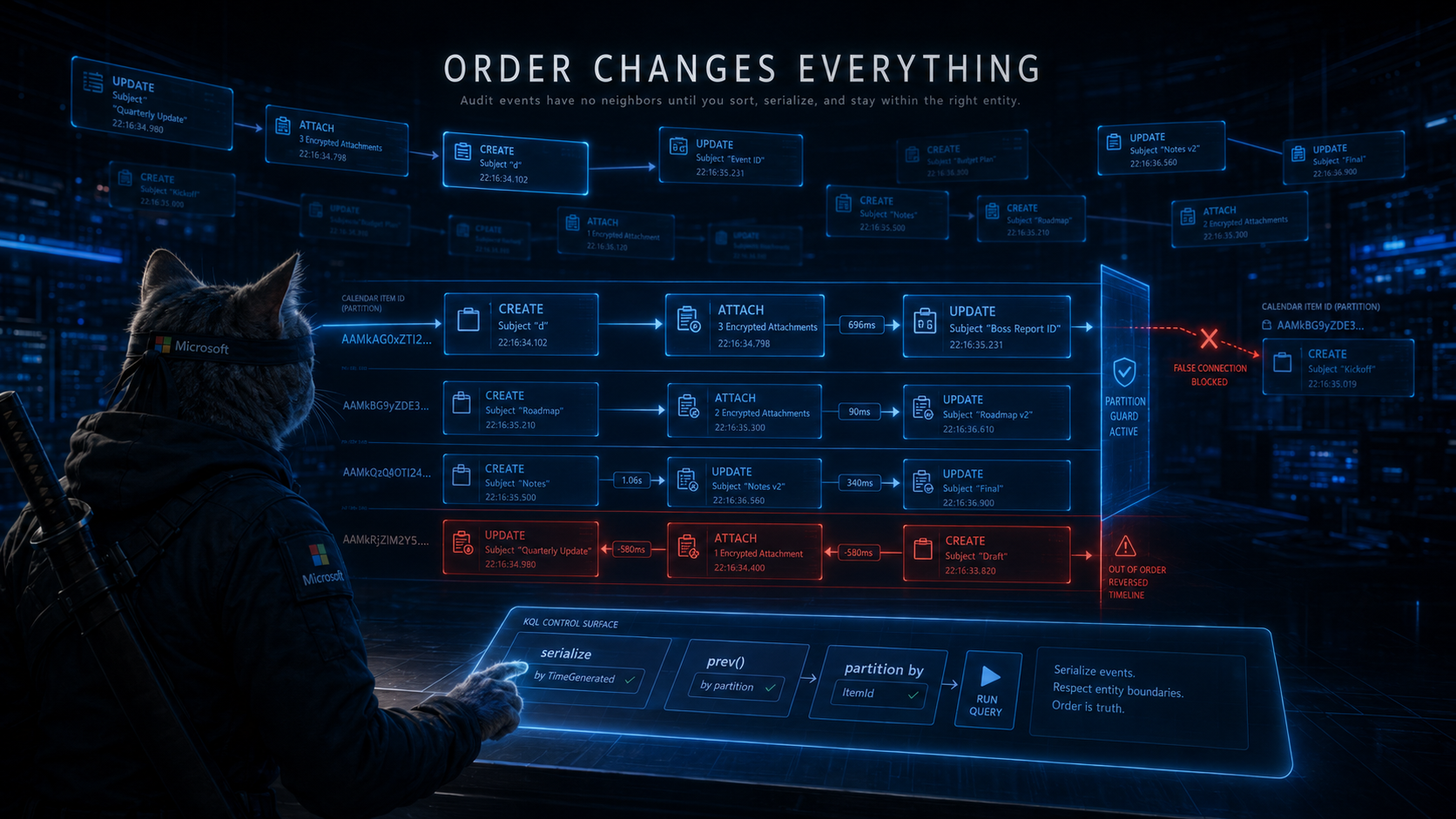
Act I’s placeholder-rename test needed something most KQL doesn’t: it needed to know what happened immediately before a given row, within that row’s own history. Last week’s bonus covered leftanti, which reasons about sets — is this key present in that population? This week’s is the other axis: reasoning about order.
Rows in KQL don’t have neighbors — until you say so
By default a KQL result set is unordered. There’s no “previous row,” because there’s no row order to be previous in. prev() and next() therefore require a serialized row set, and there are exactly three ways to get one:
| How | What it does |
|---|---|
sort by / order by |
Sorts and serializes. The usual entry point. |
serialize |
Freezes the current arbitrary order into a row order. Fast, and almost never what you want alone. |
range, top, top-hitters, getschema |
Operators that emit an already-serialized set. |
Note what is not on that list: row_number(). It’s easy to assume a function that assigns sequence numbers must be creating the sequence, but it’s the other way round — row_number() is one of the functions that requires a serialized input, exactly like prev() and next(). It reads an order someone else established. If you reach for it to fix a serialization error, you’ll get the same error back.
And serialization is not sticky. where, extend, project, and take preserve it. summarize, join, union, and mv-expand destroy it — after any of those, prev() will fail or, worse, silently operate on a re-shuffled order. If you need sequence logic after an aggregation, re-sort before you reach for prev().
The three ways prev() lies to you
prev() is a sharp tool with no guard rails, and every failure mode is silent:
sort bydefaults to descending. This is the one that gets people.| sort by TimeGeneratedgives you newest-first, soprev()returns the later event andnext()returns the earlier one. Every sequence test you wrote is now backwards. It won’t error. It’ll just return a different, plausible-looking, wrong answer — often zero rows, which reads as “clean.” Writeascexplicitly, every time, even when you think you know the default.prev()does not respect partitions. It walks the entire serialized table top to bottom. Sort byItemId, TimeGeneratedand the first row of item B sees the last row of item A as its “previous” — different entity, different timeline, fabricated sequence. The| where Mailbox == PrevMailbox and ItemId == PrevItemIdguard in Act I isn’t defensive coding, it’s required for correctness. Everyprev()needs a partition guard or apartitionoperator around it. And the guard has to name the whole key:ItemIdalone looks unique enough to guard on, but Exchange item IDs are unique within a mailbox, so a guard onItemIdby itself is one collision away from stitching two tenants’ calendars into a single sequence. If the sort key has three columns, the guard has all but the last one. The parallel to last week is exact: withleftanti, a bad key creates findings; with an unguardedprev(), a partition boundary creates sequences. Both failure modes generate exactly the artifact you were hunting for, which is the worst possible direction for a bug to fail in.prev()returns null at the boundary, and “null” means different things by type. The first row of the whole table has no predecessor. For numeric and datetime columns that’s a real null, and comparisons against it quietly evaluate false, so boundary rows vanish — usually fine, occasionally the difference between catching the first beacon and catching the second. For string columns there is no distinct null in KQL: the null value is the empty string, andisnull()on a string always returns false. Test string boundaries withisempty(). Writingisnull(PrevItemId)against a string column isn’t a bug that errors — it’s a clause that never fires, sitting in your query looking like a guard.
The three ways to write a sequence detection
prev() is one of three, and they trade off differently:
// 1. prev() with a partition guard — cheapest, best for adjacent-pair tests
| sort by Mailbox asc, ItemId asc, TimeGenerated asc
| extend PrevOp = prev(Operation), PrevId = prev(ItemId), PrevMbx = prev(Mailbox)
| where Mailbox == PrevMbx and ItemId == PrevId
      and PrevOp =~ "Create" and Operation =~ "Update"

// 2. partition — same logic, guard enforced by the operator instead of by you.
//    partition takes ONE column, so a compound entity needs a synthetic key first.
//    Viable only on LOW-cardinality keys: it materialises a subquery per partition,
//    so a per-item key across a tenant is the wrong tool. See the note below.
| extend PartKey = strcat(Mailbox, "|", ItemId)
| partition by PartKey (
    sort by TimeGenerated asc
    | extend PrevOp = prev(Operation)
    | where PrevOp =~ "Create" and Operation =~ "Update"
)

// 3. summarize + make_list — best when you want the whole ordered history
| sort by Mailbox asc, ItemId asc, TimeGenerated asc
| summarize OpSequence = make_list(Operation), Subjects = make_list(ItemSubject)
    by Mailbox, ItemId
| where array_length(OpSequence) >= 2
| where tostring(OpSequence[0]) =~ "Create" and tostring(OpSequence[1]) =~ "Update"
Option 2 looks like the safest of the three — the operator enforces the boundary so you can’t forget the guard — and for Act I it’s the wrong choice, which I had backwards until someone checked the syntax and the check turned up something bigger.
Two constraints, one of which I asserted the opposite of in an earlier draft. First, partition takes a single column, so a compound entity needs a synthetic key built with strcat before you can partition on it at all. Second, and the one that actually decides it: partition materialises a subquery per distinct value of the key. Mailbox × ItemId across a tenant is hundreds of thousands of distinct values, easily millions over a seven-day window. That isn’t a query that runs slowly; it’s a query that hits a partition-count limit or takes your workspace with it. The available strategies trade off differently but none of them make a per-item key across a tenant viable.
So the rule is about cardinality, not convenience. partition earns its keep on a key with a few hundred or a few thousand values — per-device, per-account, per-rule — where materialising a subquery each is cheap and the enforced boundary is free safety. On a per-item key, Option 1’s manual guard is not the compromise. It’s the correct answer, and the guard being your responsibility is the price of a construct that scales to the cardinality you actually have.
And the reason this correction is in the article rather than quietly patched: I wrote a comment claiming composite partition keys were supported, in the same paragraph where I told the reader to go verify the hint strategy in their own workspace. Assert something about an operator’s grammar without checking it, while instructing someone else to check — that’s the same failure as the has_any model two sections up, and I’d rather it stay on the page than be edited out of it.
Option 3 is what you want when the question is “show me the whole story of this item” rather than “did these two things happen back to back” — but note that make_list only preserves order if the input was serialized first, so the sort is doing real work, not decoration.
Option 3 also has a trap in it that I walked into on the first draft, and it’s the same one from the honorable mention wearing a third outfit. The tempting way to test the sequence is to flatten the array and string-match it:
| where tostring(OpSequence) has 'Create","Update' // don't
That looks like it’s asserting adjacent array elements, because you can see the "," between them. It isn’t. has is a term test, and the punctuation isn’t part of the term — so the separator you wrote to mean “these two sit next to each other in the array” is not something the predicate evaluates. Whether it returns the right rows in any given workspace depends on tokenizer behaviour that Microsoft documents as term presence and doesn’t specify further, which means you’re relying on something you can’t check and can’t cite. Index the array as an array: OpSequence[0] and OpSequence[1] are asking about positions, positions are what you meant, and the answer doesn’t change with the engine. The general rule this article keeps landing on from different directions — if your data is structured, compare it as structured data; don’t flatten it to a string and pattern-match the punctuation back out. If you need “did this pair occur anywhere in the history” rather than “did it open the history,” mv-apply with_itemindex over the list is the honest version: more typing, and it says what it does.
For genuine multi-stage state machines — sign-in, then rule creation, then bulk download, in that order, within a window — none of these three is right. That’s the scan operator, which walks a serialized table maintaining explicit state and is the correct tool for the M365 chain detection in Sunday’s brief. scan is heavier and considerably less readable, but it’s the only one of the four that can express “these five things, in this order, with backtracking.”
The self-check that makes sequence detections trustworthy
Same habit as last week, different shape. Before you trust a prev() result, prove the partition guard is doing something:
let Base = OfficeActivity
| where TimeGenerated > ago(1d)
| where OfficeWorkload =~ "Exchange"
| extend ItemId  = tostring(parse_json(Item).Id)
| extend Mailbox = coalesce(tostring(MailboxGuid), MailboxOwnerUPN)
| where isnotempty(ItemId) and isnotempty(Mailbox)
| sort by Mailbox asc, ItemId asc, TimeGenerated asc
| extend PrevItemId = prev(ItemId), PrevMailbox = prev(Mailbox);
union
    (Base | summarize Rows = count() | extend Population = "All rows"),
    (Base | where Mailbox == PrevMailbox and ItemId == PrevItemId
          | summarize Rows = count() | extend Population = "Same item, same mailbox"),
    (Base | where ItemId == PrevItemId and Mailbox != PrevMailbox
          | summarize Rows = count() | extend Population = "Item ID collision ACROSS mailboxes"),
    (Base | where ItemId != PrevItemId or isempty(PrevItemId)
          | summarize Rows = count() | extend Population = "Partition boundary (discarded)")
Three things to read off it. First, the counts must reconcile — if they don’t, your sort key isn’t what you think it is. Second, and the reason the third row is there: “item ID collision across mailboxes” should be zero, and if it isn’t, a guard on ItemId alone would have manufactured that many fabricated sequences. That row is the empirical test of whether your partition key is the whole entity or just the part of it that looked unique. Run it before you decide the compound key is paranoia. Third: if the discarded boundary count is nearly the whole table, your sequence detection has almost nothing to work with. Most calendar items are touched exactly once, so most rows are boundaries. That’s expected here. But if you run the same check against process events and find 95% boundaries, your partition key is too granular and the sequence you’re hunting can’t exist in the data as keyed.
The one-line takeaway: leftanti reasons about membership, prev() reasons about order, and order is the more fragile of the two — because a sort direction and a partition boundary are both invisible when they’re wrong. Say asc out loud. Guard the partition. Then the sequence means something.
The Bigger Lesson
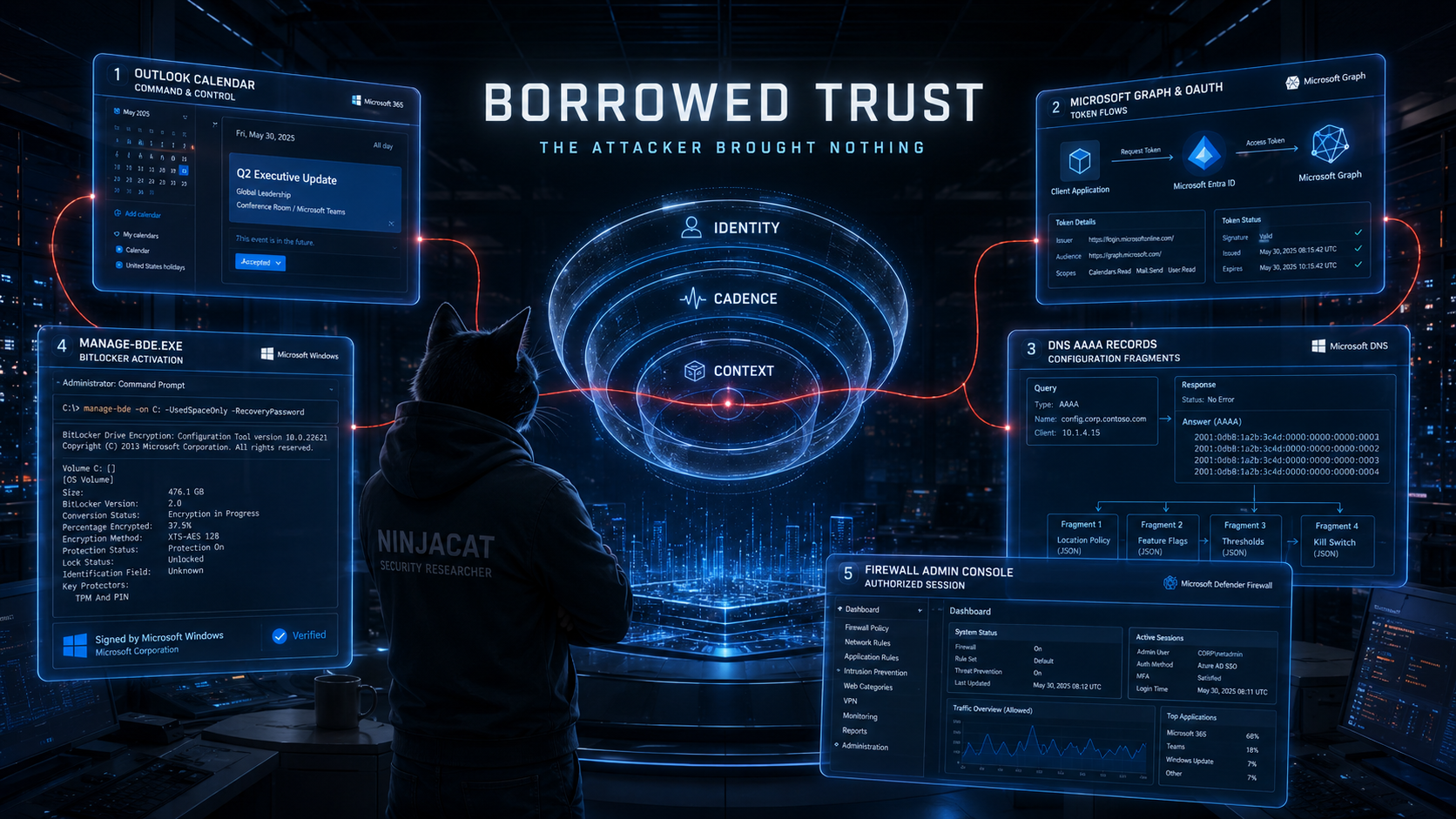
Seven briefs, twenty-eight candidates, and one thread running through nearly all of them: this week’s attackers didn’t bring anything.
- The C2 was a calendar. Not a domain you can block, not a beacon you can fingerprint — an app-only token, a Graph API call, and an appointment in 2050 that no human will ever open (Act I). When the channel is trusted infrastructure, the detection has to move to the shape of the usage: a placeholder subject, a rename seconds later, a protocol constraint the operator can’t rename away.
- The malware’s best tell was its own housekeeping. Not the encryption, not the tradecraft, not the dead drop — a config file written to disk because the developers wanted persistence across restarts, and a module that has to be loaded by name before any of it happens (Act II). Two filename matches beat everything clever in this article on cost-per-unit-confidence, and they will both stop working in the same commit. Look for the artifact the adversary created for their own convenience rather than the one they built to hide — then write down the date, because that class of signal buys you months, not years.
- The fallback channel was a record type. Sixteen bytes at a time, formatted as IPv6 addresses that were never meant to be routed anywhere (honorable mention). And the reason to check your DNS ingestion this week rather than next: if
QueryTypeisn’t in your workspace, this detection is unbuildable and you don’t currently know that. - The encryptor was
manage-bde.exe. Wednesday and Thursday both covered BitLocker turned against its owners for extortion — Microsoft-signed, already installed, already trusted, already excluded from half the EDR policies in the industry. Worth a QA note before you deploy either version: both briefs mapped that detection to T1505.003 Web Shell, inherited from the initial-access step in the source reporting. The encryption behavior is T1486 Data Encrypted for Impact, with T1490 Inhibit System Recovery and T1021.001 Remote Desktop Protocol alongside it. Thursday’s tags carried T1486; the MITRE line didn’t. Fix it before it lands in your coverage map, because a mismapped detection reports coverage you don’t have. Also worth checking: Thursday’s version bounds both the RDP logon and themanage-bdeexecution by the sameago(1h)lookback, which means theTimeDeltaMinutes <= 60correlation window can never actually be exercised at its stated width — and thenot(ipv4_is_private(RemoteIP))filter scopes it to internet-facing RDP only, missing the far more common pivot from an already-compromised internal host. - And the admin console was your firewall’s. CVE-2026-16232 ran Friday through Sunday across six candidates, all of them variations on the same problem: distinguishing an authenticated administrative session from an authenticated administrative session. All six were filed as requires environment mapping, which is exactly right and exactly the point — you cannot detect abuse of a trusted tool without first knowing who is supposed to be using it, from where.
Last week’s grammar was corroboration: what should have come with this, and where is it? This week’s is provenance of a different kind: this action is normal — but is this actor, from this place, at this cadence, normal too? When the adversary stops importing infrastructure and starts renting yours, the artifact stops being evidence. The only things left to reason about are identity, cadence, and context — and every one of those has to be baselined before it can be alerted on.
Which is the unglamorous conclusion: the detections in this article are downstream of an inventory. Which service principals touch Graph. Which processes are allowed to. What your DNS telemetry actually contains. Who administers the firewall. None of that is a query. All of it is prerequisite.
Every one of these came straight out of this week’s daily briefs — each detection shipped with ATT&CK mappings, telemetry requirements, deployment gates, triage runbooks, false-positive notes, and an honest readiness call. Twenty-eight of them this week, and the ones I disagreed with were the ones worth writing about.
This kind of detection content is published daily — fresh threat intel translated straight into deployable detections, so you spend your time tuning and shipping instead of reading and re-deriving — that’s the whole point of the Daily Detection Engineering Brief at DevSecOpsDadAttack.com.
Helpful Links and References:
This Week’s Detection Engineering Briefs:
- Monday, 20th July
- Tuesday, 21st July
- Wednesday, 22nd July
- Thursday, 23rd July
- Friday, 24th July
- Saturday, 25th July
- Sunday, 26th July
DevSecOpsDadAttack Tags:
- detection-engineering
- kql
- Project CAV3RN
- OilRig
- APT34
- Microsoft Graph
- Outlook
- Dead Drop
- DNS
- AAAA
- serialize
- prev
- Sequence Detection
- Service Principal
- OAuth
- BitLocker
- CVE-2026-16232
- T1102
- T1102.002
- T1071.004
- T1132.001
- T1573.002
- T1486
- T1490
- T1021.001
- Microsoft Sentinel
- Defender XDR
- Entra ID
ATT&CK Coverage in This Article:
Detected by the queries above:
- T1102.002 — Web Service: Bidirectional Communication (calendar dead drop — Act I from the mailbox tenant, Act II from the endpoint)
- T1071.004 — Application Layer Protocol: DNS (configuration recovery — honorable mention)
- T1132.001 — Data Encoding: Standard Encoding (hex agent ID in the query labels, 16-byte AAAA containers — honorable mention, shape lane)
Present in the malware, not detected here:
- T1573.002 — Encrypted Channel: Asymmetric Cryptography (RSA-OAEP + AES-256-GCM on the calendar attachments). This is why the dead drop’s contents are opaque; nothing in this article fires on it. Listed for completeness, not claimed as coverage.
Discussed as a correction, not covered by any query here:
- T1486 / T1490 / T1021.001 — BitLocker extortion chain, correcting the briefs’ inherited T1505.003 mapping (see The Bigger Lesson). No query in this article detects any of the three.
A note on the three branches that aren’t in any of those lists. Act II’s ConfigWrites and ModuleLoads deliberately carry no technique mapping, and that’s not an oversight — logAzure.txt and AzureCommunication.dll are artifacts, not behaviors. There’s no ATT&CK cell for “the developers wrote their config to disk.” The nearest candidates are wrong in a way worth naming: T1552.001 Credentials In Files describes an adversary searching for credentials, not creating them, and T1574.002 DLL Side-Loading asserts a loading mechanism GReAT’s analysis doesn’t establish.
Act I’s service principal lane doesn’t map either, and that one I got wrong first. It carried T1550.001, Use Alternate Authentication Material: Application Access Token, which is the mapping everyone reaches for when an app-only identity shows up in Graph. Read the technique, though: it describes an adversary replaying stolen tokens to bypass authentication. CAV3RN doesn’t do that. It holds a client ID and secret — the ones sitting in logAzure.txt — and runs an ordinary client_credentials flow to mint its own. Possessing credentials and authenticating with them is not reuse of stolen authentication material, and the difference isn’t pedantic: one is token theft, the other is an application doing exactly what an application does.
The detection makes the case worse rather than better. What AADServicePrincipalSignInLogs anti-joined against a Graph baseline returns is “a service principal authenticated to Graph that hadn’t before.” That result is equally consistent with an attacker-registered application, a legitimate registration with an attacker-added secret, and a genuinely replayed token — and the query cannot separate them. Every neighbouring candidate fails on the same fact: T1098.001 Additional Cloud Credentials fits if the secret was added to an existing app, T1078.004 Valid Accounts: Cloud Accounts fits if the registration was pre-existing and legitimate, and the analytic establishes neither. A detection that can’t distinguish between three techniques doesn’t cover any of them. It covers an observation.
Forcing any of these in would make four of the strongest detections in this article report coverage they don’t have — the exact failure the BitLocker note above describes, committed a few lines below it. Which is worth saying plainly: that’s five mapping corrections in one article, four of them mine. The pattern isn’t carelessness about ATT&CK, it’s that mapping is the step where a plausible answer and a correct answer look identical, and nothing downstream ever contradicts a wrong one. A bad KQL filter returns strange rows and you notice. A bad technique mapping returns a green cell on a coverage map and stays there for a year. If your coverage map can’t represent a detection that has no technique, that’s a gap in the map, not a licence to invent one.
External Sources:
- Kaspersky GReAT / Securelist. New Project CAV3RN module abuses Outlook calendar events for C2 and DNS AAAA records for configuration recovery. 21 July 2026. https://securelist.com/project-cav3rn-cyberespionage-framework-using-outlook-and-dns/120757/
- Kaspersky GReAT / Securelist. A new extortion cocktail: office printers, small ransoms, and BitLocker. https://securelist.com/new-extortion-scheme-printers-bitlocker/120718/
- Check Point Research. Cavern Manticore: Exposing an Iran-Linked Modular C2 Framework. https://research.checkpoint.com/2026/cavern-manticore-exposing-iran-linked-modular-c2-framework/
- Microsoft Security Blog. Email threat landscape: Q2 2026 trends and insights. https://www.microsoft.com/en-us/security/blog/2026/07/23/email-threat-landscape-q2-2026-trends-and-insights/
Stay Ahead of Emerging Threats
Looking for actionable threat intelligence and detection engineering insights?
DevSecOpsDadAttack publishes daily:
📈 Threat Intelligence Briefs focused on active campaigns, exploitation trends, and operational risk
🛠️ Detection Engineering Briefs with ATT&CK mappings, telemetry requirements, KQL detections, tuning guidance, and triage workflows
🔍 Practical analysis designed for SOC teams, threat hunters, detection engineers, and security leaders
Visit DevSecOpsDadAttack.com for the latest intelligence and detection content.
📚 Want to go deeper?
Anyone can aggregate threat intel. Very few teams can prove why they acted—or why they didn’t.
The below books are about closing that gap; turning curated signal into defensible decisions across KQL, PowerShell, and the Microsoft security stack.
🛠️ KQL Toolbox: Turning Logs into Decisions in Microsoft Sentinel

🧰 PowerShell Toolbox: Hands-On Automation for Auditing and Defense

📖 Ultimate Microsoft XDR for Full Spectrum Cyber Defense
Real-world detections, Sentinel, Defender XDR, and Entra ID — end to end.